Fast Facts
History
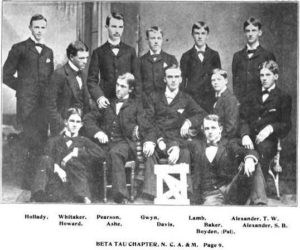
In 1895, Sigma Nu (founders pictured to the right) became the first fraternity to charter at NC State. Following enrollment trends of the University, it wasn’t until 1960 that our first women’s organization was established with the charter of Sigma Kappa, and 1971 that Alpha Phi Alpha became the first African American organization on campus. Our Culturally based organizations that would later form the Multicultural Greek Council established organizations on campus in the late 90s and early 2000s. More than 125 years after the first fraternity, NC State is a robust community of fraternities and sororities with 51 organizations and over 3,800 members.
Departmental Overview
The Department of Fraternity and Sorority Life (FSL) aims to prepare students for society through a values-based fraternal experience. Focusing on Chapter Services, Council and Community Development and the Living/Learning Experience, the Department provides holistic development of affiliated students. The fraternity/sorority experience is a great compliment to the academic mission of the University. Providing students with a sense of belonging positively impacts retention and graduation rates of members. Opportunities for a democratic social experience and development of the individual’s potential through leadership opportunities and group effort prepare students for the classroom and careers. While outreach via service and philanthropic efforts prepare students to see themselves as engaged citizens. The fraternity/sorority experience provides a deep connection to, and affinity for the institution long after graduation and a path for students to pursue their potential.
People
- 8 Professional Team Members
- 10 House Directors and 4 Chapter Resident Directors
- 51 Chapter Presidents
- 28 Governing Council Officers
- 28 Ambassadors
Chapter Services
- The fraternity/sorority community at NC State is comprised of 51 men’s and women’s organizations including over 3,800 students representing more than 15% of undergraduates at NC State.
- Staff members meet regularly with chapter leaders, alumni, and national representatives to ensure chapters are providing meaningful experiences for their members.
- Staff also work in partnership with Student Conduct, Alcohol and Other Drugs, and Equal Opportunity to ensure accountability and education of education around issues like Title IX, hazing, social event planning, and risk reduction.
Council and Community Development
- FSL advises four governing councils within the fraternity/sorority community.
- The Interfraternity Council (IFC) is comprised of 22 men’s organizations, averaging 70 members each but ranging in size from 24-137.
- The Multicultural Greek Council (MGC) is comprised of 8 organizations that honor specific cultural traditions and average 14 members each, including Asian, South Asian, Latino/a, Native American, and Multicultural organizations.
- The National Pan-Hellenic Council (NPHC) is comprised of 8 historically African American fraternities and sororities with an average of 14 members per organization.
- The Panhellenic Association is comprised of 13 women’s organizations, 11 NPC organizations averaging 191 members each, and 2 women’s engineering organizations with 44-78 members each.
- Order of Omega inducts the top 3% of leaders from the FSL community to collaborate on programming initiatives such as mental health stigma, hazing prevention, and unity.
- Circle of Sisterhood at NC State engages sorority women throughout the community to come together to help remove barriers to education for girls and women through philanthropic effort, awareness and educational initiatives.
- Staff create intentional experiences to build relationships for student leaders across all governing councils while providing leadership development and relevant education.
Living and Learning
- Greek Village provides housing to 26 organizations and 767 residents
- 5 in University-owned houses
- 11 in chapter space within University-owned townhomes/apartments
- 10 in privately owned facilities
- Additional 11 organizations are housed in Greek Village Apartments in non-chapter space for a total of 37 organizations living in Greek Village for 2025-2026
- The Greek Village is in Phase 4 of 5 for planned redevelopment. This project will replace aging infrastructure and provide opportunities for alumni house corporations to design, build, and operate organization-owned housing on campus. A total of 21 building lots will be developed along with 275 additional beds for residents in townhomes and apartments.
- 10 full-time House Directors, 2 Coordinators, and 4 Chapter Resident Directors live on-site to ensure facility safety as well as compliance with University standards.
Select Programs and Initiatives
Greek Leaders Retreat – The Greek Leaders Retreat kicks off the new year and is an opportunity for council officers and chapter presidents to further develop as leaders. The retreat brings together about 85 student leaders of the NC State fraternity and sorority community to set their own agendas, ask their own questions, share their experiences, listen to the experiences of others, and learn as a community what it means to have the best possible experience at NC State. Topics of sessions focus on leadership, responsibility, health and safety, effective programming, and compliance.
New Member Institute – New Member Institute brings together new members from the Interfraternity Council and the Panhellenic Association for an evening focused on building connections and sessions revolving around health and wellness, risk mitigation, leadership development and community development.
Beginning of the Year Officer Meetings and Training – The Department hosts beginning of the year meetings for several officers, including Risk Management, those who oversee the organization Membership process, and Chapter Presidents. Workshops are held throughout the week before classes begin to engage more than 350 student leaders on the rights and responsibilities of their positions and prepare them for success in their roles.
Standards of Excellence and Annual Awards Program – The Standards of Excellence Program for fraternities and sororities at NC State is a template for organizational success. Developed in 2004 by a group of fraternity and sorority leaders in collaboration with staff from the Department of Fraternity and Sorority Life, the Standards Program establishes a set of organizational expectations in 10 specific areas referred to as Shared Principles. All chapters are required to participate in the Program unless they have fewer than four members or are in their first year of recognition at NC State. Successful chapters use the Program to guide the development of their activities and programs thereby creating a broad, unique experience for their members. Our Department also uses the Program to recognize outstanding organizations and individuals for their accomplishments.
EPIC Programs – Encouraging Positive Intervention in Chapters (EPIC) Programs will include training for chapters on topics of Alcohol and Other Drugs, Hazing, and Sexual Violence Prevention. This program will build capacity of chapter leaders and their members to engage with these complex topics and how they take responsibility to address them.
Hazing Prevention – The University has required all new students to complete an online course from PreventZone. Hazing Prevention: It’s Everyone’s Responsibility™ is an evidence-based online course, reflecting best practices established by leading academics studying hazing. This one-hour awareness and prevention-based course teaches students how to recognize, prevent and report hazing. To build upon that foundation, Fraternity and Sorority Life requires all chapter members and new members to complete The Fraternity & Sorority Life Module — an extension of the prerequisite course, Hazing Prevention: It’s Everyone’s Responsibility™. This 30-minute module dives deeper into the specific needs of fraternity and sorority life. Topics go beyond defining the problem and allow for real conversations and solutions. Further, the FSL staff provide annual in-person training for staff, student leaders and members on recognizing signs of hazing, reporting, and engaging in prevention efforts.
FSL Ambassadors – This group of dynamic student leaders will mentor and inform new students, their families, and other stakeholders on why being a member of the Fraternity and Sorority Life community is an impactful experience and how they can be a part of the community. We have trained 28 students to represent the department, all four councils, and the fraternal experience at NC State. These students have represented the department at summer orientation sessions, open house events, and coordinated Greek Village tours for prospective students.